

Breed standards are the official guidelines that describe the ideal characteristics, temperament, and appearance of a breed and ensures that the breed is fit for function with soundness essential.
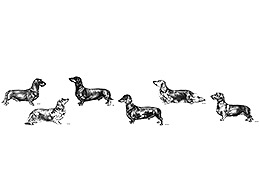
Standard adopted by Kennel Club, London 1994
Standard Adopted by ANKC 2009
Updated 2021 with revised colour clause effective 1 April 2025
Originating in Germany, the Dachshund, (Teckel) was bred to hunt small game, predominantly badger, that goes to ground. The dog was required to scent, track and pursue game into burrows. The dog was required to move over all types of terrain, including dense undergrowth and water. The Dachshund was required to have intelligence, strength, endurance and versatility, a long body with relatively short legs and three different coat types all of which combine to enable it fulfil its purpose.
Miniature Dachshunds were bred to have the same attributes as Standards, but were used to hunt smaller game.
From time to time certain conditions or exaggerations may be considered to have the potential to affect dogs in some breeds adversely, and judges and breeders are requested to refer to the Breed Watch information related to this breed for details of any such current issues (https://www.royalkennelclub.com/search/breeds-a-to-z/breeds/hound/dachshund-miniature-smooth-haired/). If a feature or quality is desirable it should only be present in the right measure. However if a dog possesses a feature, characteristic or colour described as undesirable or highly undesirable, it is strongly recommended that it should not be rewarded in the show ring.
Moderately long in proportion to height, with no exaggeration. Compact, well-muscled body, with enough ground clearance, not less than one quarter of the height at the withers to allow free movement. Heights at the withers should be half the length of the body, measured from breastbone to the rear of thigh. Bold, defiant carriage of the head and intelligent expression.
Intelligent, lively, courageous to the point of rashness, obedient. Especially suited to going to ground because of low build, very strong forequarters and forelegs. Long, strong jaw, and immense power of bite and hold. Excellent nose, persevering hunter and tracker. Essential that functional build, size and proportions ensure working ability.
Faithful, versatile and good tempered.
Long, appearing conical when seen from above; from side tapering uniformly to tip of nose. Skull only slightly arched. Neither too broad nor too narrow, sloping gradually without prominent stop into slightly arched muzzle. Length from tip of nose to eyes equal to length from eyes to occiput. In wire haired, particularly, ridges over eyes strongly prominent, giving appearance of slightly broader skull. Lips well stretched, neatly covering lower jaw. Strong jaw bones not too square or snipy, but opening wide.
Medium size, almond shaped, set obliquely. Dark except in chocolates, where they can be lighter. In dapples one or both wall eyes permissible.
Set high, and not too far forward. Broad, of moderate length, and well rounded (not pointed or folded). Forward edge touching cheek. Mobile, and when at attention back of ear directed forward and outward.
Teeth strongly developed, powerful canine teeth fitting closely. Jaws strong, with a perfect, regular and complete scissor bite, i.e. upper teeth closely overlapping lower teeth and set square to the jaws. Complete dentition important.
Long, muscular, clean with no dewlap, slightly arched, running in graceful lines into shoulders, carried proudly forward.
Shoulder blades long, broad, and placed firmly and obliquely (45 degrees to the horizontal) upon robust rib cage. Upper arm the same length as shoulder blade, set at 90 degrees to it, very strong, and covered with hard, supple muscles. Upper arm lies close to ribs, but able to move freely. Forearm short and strong in bone, inclining inwards, forming a slight crook which fits neatly around the chest. When seen in profile moderately straight, must not bend forward or knuckle over, which indicates unsoundness. Correctly placed foreleg should cover the lowest point of the keel, with ground clearance never less than one quarter of the height at the withers.
Moderately long and full muscled. Sloping shoulders, back reasonably level, blending harmoniously between withers and slightly arched loin. Withers and quarters of approximately the same height. Loin short and strong. Breast bone strong, and so prominent that a depression appears on either side of it in front. When viewed from front, thorax full and oval; when viewed from side or above, full volumed, so allowing by its ample capacity complete development of heart and lungs. Ribs extending well back with good length of sternum. Underline gradually merging into line of abdomen. Body sufficiently clear of ground to allow free movement.
Rump full, broad and strong, pliant muscles. Croup long, full, robustly muscled, only slightly sloping towards tail. Pelvis strong, set obliquely and not too short. Upper thigh set at right angles to pelvis, strong and of good length. Lower thigh short, set at right angles to upper thigh and well muscled. Viewed from the rear, hind legs straight and parallel, neither close nor wide apart.
Front feet full, broad, deep, close knit, straight or very slightly turned out. Hindfeet smaller and narrower. Toes close together, with a decided arch to each toe, strong regularly placed nails, thick and firm pads. Dog must stand true, i.e. equally on all parts of the foot.
Continues line of spine, but slightly curved, without kinks or twists, not carried above the topline, or touching ground when at rest.
Should be free and flowing. Stride should be long, with the drive coming from hindquarters when viewed from the side. Viewed from in front or behind, the legs and feet should move parallel to each other with the distance apart being the width of the shoulder and hip joints respectively.
Smooth-Haired
Dense, short and smooth. Hair on underside of tail coarse in texture. Skin loose and supple, but fitting closely all over without dewlap and little or no wrinkle.
Long-Haired
Soft and straight, or only slightly waved; longest under neck, on underparts of body and behind legs, where it forms abundant feathering, on tail where it forms a flag. Outside of ears well feathered. Coat flat, and not obscuring outline. Too much hair on feet undesirable.
Wire-Haired
With exception of jaw, eyebrows, chin and ears, the whole body should be covered with a short, straight, harsh coat with dense undercoat, beard on chin, eyebrows bushy, but hair on ears almost smooth. Legs and feet well but neatly furnished with harsh coat.
The following colours are permitted in all six varieties:
The following colours are acceptable only in the varieties specified:
Miniature Smooth-haired and Miniature Long-haired:
Smooth-haired, Miniature Smooth-haired and Miniature Long-haired:
Wire-haired and Miniature Wire-haired:
Nose and nails black in all colours except chocolate/tan and chocolate dapple where they are brown.
In all colours no white permissible, save for a small patch on chest which is permitted but not desirable.
The following colours are unacceptable in any variety:
Double dapple (where varying amounts of white occur all over the body in addition to the dapple pattern), Isabella, blue and all other colours or patterns including piebald and tricolour are unacceptable.
Ideal weight 9-12 kgs (20-26 lbs)
Miniature ideal weight 4.5kgs (10 lbs). Desired maximum weight 5kgs (11 lbs)
Exhibits which appear thin and undernourished should be severely penalised.
Any departure from the foregoing points, including desired body condition should be considered a fault and the seriousness with which the fault should be regarded should be in exact proportion to its degree and its effect upon the health and welfare of the dog as well as its ability to perform its traditional work.
Male animals should have two apparently normal testicles fully descended into the scrotum.
Note for prospective puppy buyers:
Size – The Kennel Club breed standard is a guide and description of the ideal for the breed; the size as described does not imply that a dog will match the measurements given (height or weight). A dog might be larger or smaller than the size measurements stated in the breed standard.